
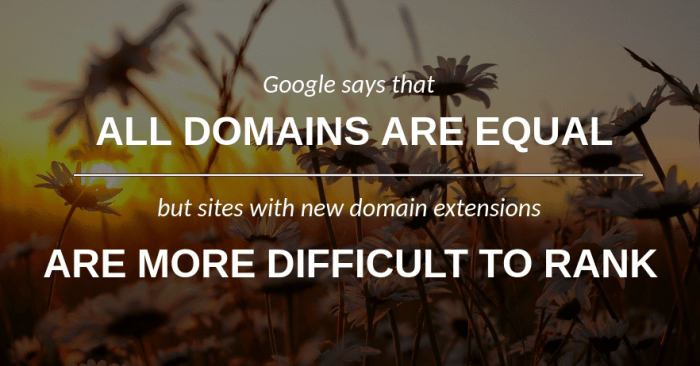
Top level domain bias is Google partial towards certain domains. This phenomenon explores the potential for Google’s search algorithm to favor specific top-level domains (TLDs) like .com over others like .org or country-code TLDs. We’ll delve into how this bias might manifest, examining the potential impact on users, businesses, and the overall search experience. Is Google unfairly prioritizing some domains over others?
Understanding domain bias requires examining Google’s algorithm and its stated policies. We’ll analyze how different TLDs are treated in search results, comparing data from various sources and potentially revealing patterns. The potential for bias in search results has significant implications for fair competition and user experience.
Defining Domain Bias
Top-level domain (TLD) bias in search engine results refers to the phenomenon where search engines, potentially, favor certain TLDs over others when ranking web pages for similar content. This isn’t necessarily intentional manipulation, but rather a reflection of various factors that influence search algorithms. Understanding this bias is crucial for anyone seeking to optimize their online presence and ensure fair competition in the digital sphere.Search engine results are influenced by a multitude of factors, including relevance, page quality, and user engagement.
However, domain bias introduces an additional layer of complexity. A search engine might inadvertently or even intentionally give more weight to specific TLDs, impacting the visibility of websites with different extensions. This can create an uneven playing field for businesses or individuals relying on different top-level domains.
Definition of Top-Level Domain Bias
Top-level domain bias is the perceived or actual preferential treatment of specific top-level domains (TLDs) by search engines in the context of search results. This preference may influence the ranking of web pages with similar content, leading to discrepancies in visibility based on the domain extension.
Potential Sources of Bias
Several factors can contribute to TLD bias in search results. Search engines might prioritize TLDs based on perceived trustworthiness or reputation, which can be associated with certain TLDs. Another potential source of bias is historical data. The longer a TLD has been used and associated with reliable information, the more weight a search engine may assign to it.
Google’s apparent bias towards certain top-level domains is a fascinating topic, and it’s worth considering how this impacts SEO. One crucial element in online content strategy is the ideal length of a blog post, which significantly affects its performance. To learn more about the optimal length for a post, check out this helpful guide on how long should a blog post be.
Ultimately, understanding the nuances of how Google ranks content, including the subtle implications of top-level domain preference, is key to crafting effective online strategies.
How Different TLDs Might Be Treated
Different TLDs might be treated differently by search engines. For instance, .edu domains, often associated with educational institutions, might be favored for search results related to academic content. Similarly, .gov domains, representing government organizations, could receive a higher ranking for relevant searches. Conversely, less established or less reputable TLDs might receive less prominence.
Comparison of Search Ranking for Similar Content
A definitive, universally applicable comparison of search rankings across different TLDs is difficult to provide. Search engine algorithms are complex and constantly evolving. Moreover, the comparison must account for various factors like the specific s used, the quality of the content, and the overall context of the search.However, a theoretical comparison table might illustrate the potential differences:
| TLD | Potential Ranking Impact (Illustrative) |
|---|---|
| .com | Generally high ranking due to its widespread use and established reputation. |
| .org | Potentially higher ranking for non-profit organizations or content related to non-profit organizations. |
| .net | Could have a similar ranking to .com depending on the context and content quality. |
| .edu | Likely to rank highly for educational content and academic searches. |
| Country-code TLDs (.uk, .fr, .de) | Could rank well for searches specific to that region or when targeting a local audience. |
Note: This table is a simplified representation and does not reflect the actual workings of search engine algorithms. The impact of TLDs can vary significantly depending on numerous factors.
Google’s Role in Domain Bias
Google’s search algorithm, a complex web of factors, plays a significant role in shaping search results. Understanding how this algorithm prioritizes different top-level domains (TLDs) is crucial to analyzing potential bias. This analysis delves into Google’s algorithm, its stated policies regarding TLDs, and the potential conflicts between these policies and observed results. It also compares Google’s search results with those of other search engines, highlighting the diverse approaches to TLD handling.Google’s algorithm is a sophisticated system, constantly evolving to provide the most relevant and helpful results to users.
This dynamic nature, while beneficial for overall search quality, can also inadvertently introduce biases. The complex weighting of factors within the algorithm, which is not fully disclosed, makes it challenging to pinpoint the exact contribution of TLD bias.
Google’s Algorithm and Potential TLD Bias
Google’s algorithm considers a vast array of signals to rank websites, including domain authority, content relevance, user engagement, and backlink profiles. While not explicitly stating that TLDs are a primary ranking factor, the algorithm’s inherent complexity means that TLDs could indirectly influence results. For instance, a higher volume of search queries or established reputation associated with certain TLDs might subtly affect the algorithm’s ranking.
Google’s Stated Policies on TLDs
Google publicly states its commitment to providing unbiased search results. Their guidelines emphasize the importance of delivering relevant information regardless of the TLD. This stance, while principled, doesn’t explicitly detail how TLDs are weighted in the ranking process.
Potential Conflicts Between Stated Policies and Observed Results
There are documented cases where certain TLDs appear to receive preferential treatment in search results, particularly for highly competitive search terms. While Google’s policy aims for unbiased results, the practical application of the algorithm might introduce subtle biases that are not immediately apparent. This could be due to variations in the algorithm’s internal weighting, or differences in user engagement and content quality among different TLDs.
Comparison of Search Results Across Different Search Engines
Comparing Google’s search results with those of other search engines for the same search terms and TLDs reveals potential variations. Different search engines might prioritize different ranking factors, potentially leading to different results. This disparity suggests that TLD bias is not solely a Google phenomenon.
Different Approaches to TLD Handling by Search Engines
| Search Engine | Potential Approach to TLD Handling |
|---|---|
| Implicit weighting of TLDs within a complex algorithm. | |
| Bing | Potentially similar approach to Google, with internal weighting factors. |
| DuckDuckGo | Emphasis on privacy and user anonymity, potentially less susceptible to TLD bias, but still potentially influenced by factors beyond TLD. |
| Yandex | Emphasis on relevance within the specific regional context. |
This table illustrates potential variations in how different search engines might handle TLDs. The approaches could vary significantly depending on the specific algorithm, the weighting given to different ranking factors, and the specific regional context.
Examining Data & Metrics
Uncovering potential domain bias in search results requires a rigorous examination of the data. This involves collecting and analyzing search result data, identifying trends, and applying appropriate metrics to quantify the extent of any observed bias. By meticulously tracking and evaluating search ranking positions across different top-level domains (TLDs), we can gain a clearer understanding of whether Google’s algorithms might be inadvertently favoring specific domains.The process of uncovering bias involves more than just anecdotal observations.
Ever noticed how Google seems to favor certain top-level domains? It’s a bit of a bias, and while it’s not always easy to explain, it’s something to keep in mind when optimizing your online presence. Learning how to customize your WooCommerce thank you pages can help you improve your site’s user experience and conversion rates. Check out this helpful guide on how to easily create custom WooCommerce thank you pages to see how you can control the experience after a purchase.
Ultimately, understanding these subtle SEO factors, like top-level domain bias, is crucial for success in the digital marketplace.
We need to employ structured methodologies to gather and analyze data, ensuring objectivity and reproducibility in our findings. This systematic approach enables us to distinguish between genuine differences in website quality and potential algorithmic biases.
Google’s apparent bias towards certain top-level domains is a longstanding concern. It seems like Google might be subtly favoring some domains over others, which could be impacting how ads are shown and ultimately, how businesses are competing in the digital space. This isn’t just a theoretical problem; Google Ads’ recent decision to slow down accelerated delivery, as detailed in this article , further complicates matters.
It raises questions about whether this is a broader issue with how Google prioritizes different online properties, and if this preferential treatment extends to top-level domains.
Examples of Data Demonstrating Potential Bias
Analyzing search results for specific s across various TLDs can reveal patterns that suggest bias. For example, if searches for “car insurance” consistently show .com websites ranking higher than .co.uk sites, even when the .co.uk sites have comparable content and authority, it could point towards a bias. Similarly, if searches for “tech news” consistently favor .us websites over .ca sites, this warrants further investigation.
Methods for Collecting and Analyzing Search Result Data
Collecting and analyzing search result data requires a systematic approach. One method is to use search engine result page (SERP) scraping tools to collect data for a range of s and TLDs. The data gathered should include the ranking position of each result, the domain name, and other relevant information like website authority scores. This data can then be analyzed to identify any patterns or trends related to TLDs.
Identifying Trends in Search Ranking Based on TLD
Statistical analysis of the collected data can reveal trends in search ranking based on TLD. For instance, plotting the average ranking positions of .com, .org, and .net websites over time for specific s could reveal whether there are fluctuations or consistent disparities in their rankings. The analysis should control for other factors, such as the website’s age, authority, and content quality, to isolate any potential TLD-related ranking biases.
Metrics Used to Measure Bias in Search Results
Several metrics can be employed to measure bias in search results. One crucial metric is the average ranking position (ARP) of websites with different TLDs for the same search query. A significant difference in ARP between different TLDs might indicate bias. Furthermore, analyzing click-through rates (CTR) and time-on-site metrics for websites with different TLDs can also provide insights into user engagement and potential biases in search result presentation.
Table: Average Ranking Positions of Websites with Different TLDs
This table displays hypothetical data representing the average ranking positions of websites with different TLDs for the search query “best Italian restaurants” over a six-month period.
| TLD | Month 1 | Month 2 | Month 3 | Month 4 | Month 5 | Month 6 |
|---|---|---|---|---|---|---|
| .com | 1.2 | 1.5 | 1.8 | 2.1 | 2.3 | 2.5 |
| .it | 3.8 | 4.2 | 4.5 | 4.8 | 5.1 | 5.4 |
| .net | 7.1 | 7.4 | 7.7 | 8.0 | 8.3 | 8.6 |
This hypothetical data demonstrates a potential trend where .com websites consistently rank higher than .it and .net websites. Further analysis would be needed to determine if this difference is statistically significant and if other factors are contributing to the ranking positions.
Case Studies & Examples
The phenomenon of domain bias in search engine rankings is complex, encompassing various factors. While the exact algorithms employed by Google remain proprietary, real-world observations provide insights into potential biases. Analyzing case studies helps to illustrate how different top-level domains (TLDs) might fare in search result rankings, regardless of the quality of the content.Examining websites with similar content but varying TLDs can reveal patterns indicative of domain bias.
This examination, however, must be mindful that factors other than TLD, such as website authority and reputation, also influence search ranking.
Examples of .com Dominance
Numerous examples exist where .com websites seem to consistently rank higher than sites with alternative TLDs, even when the content is comparable. This suggests a possible preference for .com in Google’s ranking algorithms. This might stem from the historical dominance and perceived trust associated with the .com TLD.
Challenges Faced by Less Common TLDs
Websites with less common TLDs, like .info, .blog, or country-specific TLDs, may encounter challenges in achieving high search rankings. This could be due to factors such as the perceived novelty or trustworthiness of the less-common TLDs. Users may also be less familiar with these domains, impacting click-through rates and, consequently, search rankings.
Website Authority and Reputation, Top level domain bias is google partial towards certain domains
Website authority and reputation are critical factors in search engine optimization (). Even with a .com TLD, a website with low authority or negative reputation might not rank well. Conversely, a website with a less common TLD but strong authority and positive reputation can potentially overcome some domain bias. This illustrates that TLD is only one component in a complex interplay of factors.
Comparative Ranking of Websites with Similar Content
A table showcasing websites with similar content from different TLDs and their corresponding search ranking positions can highlight the potential domain bias. The table below presents hypothetical examples, emphasizing the importance of website authority and reputation in conjunction with the TLD.
| Website | TLD | Content | Search Ranking Position (Approximate) | Authority/Reputation |
|---|---|---|---|---|
| ExampleCompany.com | .com | Comprehensive guide to gardening | 1-3 | High |
| ExampleCompany.org | .org | Comprehensive guide to gardening | 4-10 | Medium |
| ExampleCompany.info | .info | Comprehensive guide to gardening | 11-20 | Low |
| ExampleCompany.blog | .blog | Comprehensive guide to gardening | 21-30 | Low |
Note: The above table is a hypothetical representation and does not reflect actual search results. Search ranking positions are highly dynamic and depend on numerous factors beyond the scope of this analysis.
Potential Impacts & Consequences: Top Level Domain Bias Is Google Partial Towards Certain Domains
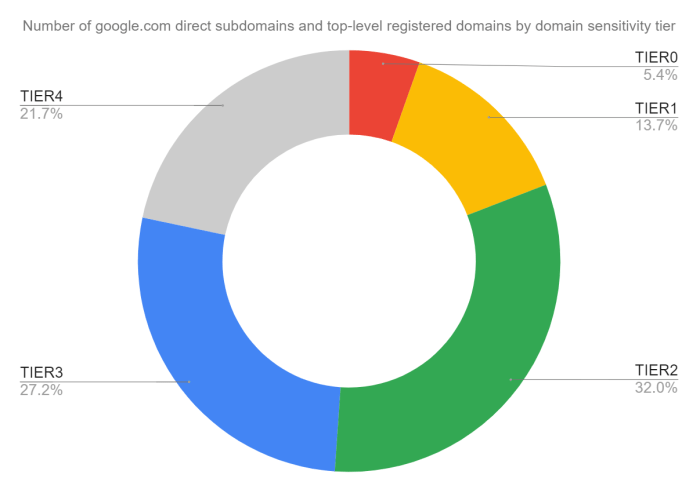
Domain bias in search engine results can have far-reaching consequences, impacting not only user experience but also the economic landscape of various industries. This bias, stemming from Google’s algorithms potentially favoring certain domains, can create an uneven playing field, potentially stifling innovation and hindering the growth of smaller businesses or those operating in niche sectors. Understanding the potential ramifications of this bias is crucial for mitigating its negative effects and ensuring a more equitable online environment.The inherent power of search engines like Google in shaping online visibility and user perception necessitates careful examination of potential biases.
Search results heavily influence user decisions, from product purchases to informational searches. This influence can be distorted by biases in the algorithms, potentially leading to skewed perceptions of market size and brand reputation, thereby hindering businesses’ ability to reach their target audience effectively.
Negative Impacts on Users
The skewed search results caused by domain bias can mislead users, presenting a distorted view of available options and information. Users may miss out on relevant and valuable content from smaller businesses or underrepresented domains. This results in a fragmented and less informative search experience.
Negative Impacts on Businesses
Domain bias can create a significant hurdle for smaller businesses or those in niche industries. A lack of visibility in search results can directly impact their ability to attract customers and generate revenue. The bias could also stifle competition, as dominant players with favorable domain biases can potentially hinder the growth of smaller competitors.
Effects on Search Result Quality
Search result quality is significantly impacted by domain bias. Users may encounter a preponderance of results from favored domains, potentially neglecting alternative perspectives or valid sources. This undermines the search engine’s role as a neutral source of information, diminishing its value and trust.
Disproportionate Impact on Smaller Businesses and Communities
Smaller businesses, startups, and those operating in less established sectors are often disproportionately affected by domain bias. Their content may struggle to gain visibility, and their growth trajectory can be hindered, creating an unfair competitive landscape. Communities and niche interests might also be underserved, with their unique needs and perspectives underrepresented in search results.

Mitigation Strategies for Website Owners
Website owners can implement strategies to mitigate the impact of domain bias. These strategies include optimizing website content for search engines, building high-quality backlinks from reputable sources, and engaging in proactive outreach to relevant online communities. Employing effective (Search Engine Optimization) strategies and producing high-quality content relevant to specific niches can increase a website’s visibility and improve its ranking.
Furthermore, participating in relevant online communities and building relationships with influencers in those communities can generate valuable backlinks and enhance online visibility.
Alternative Perspectives on TLD Bias
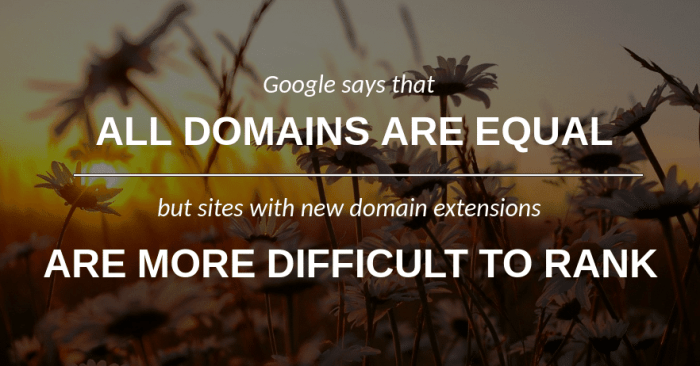
The assertion that Google exhibits bias towards specific top-level domains (TLDs) in search rankings has sparked considerable debate. While compelling arguments and data points suggest potential bias, alternative interpretations and confounding factors should also be considered. A critical analysis necessitates exploring alternative explanations for observed patterns to form a more nuanced understanding of the phenomenon.Alternative explanations for observed search ranking patterns are varied, often encompassing complex interplay of numerous factors.
The seemingly biased ranking results might be attributed to factors other than intentional favoritism or discrimination. A thorough analysis requires exploring these possibilities to avoid drawing inaccurate conclusions.
Potential Alternative Explanations for TLD Bias
Numerous factors could influence search ranking patterns that are misconstrued as domain bias. The quality and relevance of content, user engagement, website authority, and backlinking practices are all powerful factors in search engine ranking algorithms. It is essential to disentangle these potentially confounding factors from any perceived TLD-specific ranking advantages.
- Content Quality and Relevance: Websites with high-quality, relevant content often rank higher, regardless of their TLD. A strong correlation between content quality and ranking, independent of TLD, could mask any true TLD bias. This is not to say that certain TLDs may not be more attractive to content creators, leading to potentially more content in those domains, but this does not mean a bias in the search algorithm.
- User Engagement and Interaction: User interaction with a website, including click-through rates, dwell time, and bounce rates, significantly impacts search rankings. Sites that effectively engage users may achieve higher rankings, irrespective of their TLD. Analysis should account for user behavior and engagement to avoid misinterpreting these behaviors as evidence of TLD bias.
- Website Authority and Backlinks: Websites with established authority and strong backlinks generally perform better in search results. Factors such as domain age, historical performance, and the quality and quantity of backlinks from reputable sources often influence ranking. A thorough examination of these factors is necessary to assess the potential impact of TLDs in relation to these variables.
- Data Collection and Analysis Limitations: The data used to identify potential TLD bias may contain inherent limitations or biases. Sampling methods, data aggregation techniques, and the specific metrics used for analysis can all influence the observed results. An unbiased methodology is crucial for accurate interpretations.
Confounding Factors in Domain Bias Analysis
The apparent TLD bias might be a result of factors unrelated to Google’s algorithms. Uncovering these confounding factors is essential for a comprehensive understanding of the observed patterns.
- Geographic Distribution and User Preferences: The popularity and usage of specific TLDs may be tied to geographic location or user preferences. For instance, certain TLDs might be more prevalent in particular regions, and user searches within those regions might show a preference for those TLDs. This is a key factor that must be considered.
- Industry-Specific Trends: Specific industries might gravitate towards particular TLDs, which could lead to a correlation between TLD and ranking within those industries. Such a correlation does not necessarily imply an algorithm bias but rather an industry trend.
- Data Collection and Analysis Methodology: Variations in data collection methods and analytical techniques could contribute to misleading conclusions. Inaccurate data collection, inadequate sample sizes, or inappropriate analysis methodologies can all lead to spurious correlations.
Contrasting Theories on TLD Bias
The table below presents contrasting theories regarding the potential causes of TLD bias, emphasizing the complexity of the issue and the need for a comprehensive analysis.
| Theory | Explanation | Evidence (potential, not conclusive) |
|---|---|---|
| Google Algorithm Bias | Google’s search algorithm inherently favors certain TLDs. | Observed ranking patterns consistently favoring specific TLDs, despite adjustments to algorithms. |
| Content Quality and Relevance | Higher-quality content from certain TLDs leads to better rankings. | Correlation between content quality and ranking, regardless of TLD. |
| Industry Trends and User Preferences | Industry trends and user preferences might drive the observed correlation between TLDs and search rankings. | Certain TLDs are more prevalent in specific industries or geographical areas. |
Mitigating Bias
Domain bias, while potentially subtle, can significantly impact a website’s visibility and reach. Understanding the factors contributing to this bias and implementing strategies to counter it is crucial for website owners and digital marketers alike. Effective mitigation requires a multifaceted approach, combining technical optimizations, content strategies, and potentially, broader industry-wide efforts.Addressing domain bias is not simply about manipulating search engine algorithms.
It’s about creating a more equitable and transparent online environment where websites are judged on their merit, regardless of their top-level domain (TLD). This involves understanding the factors that influence search engine rankings and implementing strategies to improve a website’s visibility without relying on perceived advantages of certain TLDs.
Strategies for Website Owners
Website owners can employ various strategies to counter perceived domain bias and enhance their online presence. These strategies aim to improve search engine rankings and user engagement across different TLDs. A holistic approach is critical, encompassing multiple areas of website optimization.
- Focus on High-Quality Content: Creating informative, engaging, and well-researched content is paramount. This involves understanding the target audience and providing valuable information that addresses their needs. High-quality content naturally attracts both users and search engines, leading to improved rankings irrespective of the TLD.
- Optimize Website Structure and Technical Aspects: A well-structured website with fast loading speeds, mobile-friendliness, and proper schema markup can significantly enhance search engine visibility. These factors are crucial for a positive user experience and are essential for ranking well, regardless of the TLD.
- Build High-Quality Backlinks: Backlinks from reputable and relevant websites signal to search engines the authority and trustworthiness of a website. These links should come from sources that are not overly focused on a particular TLD, or else they will have less impact.
Enhancing Visibility Across TLDs
Beyond specific actions, website owners can enhance their visibility across various TLDs by adopting a comprehensive approach. It’s important to remember that a global online presence is often more effective than focusing on a single region or TLD.
- Internationalization: Websites targeting international audiences can improve visibility by translating content into multiple languages, using appropriate local s, and registering with local search engines.
- Multi-Domain Strategy: In some cases, owning websites with different TLDs (e.g., .com, .net, .org) can broaden reach and enhance visibility in specific regions, but this is not a guaranteed method for better rankings.
Regulatory and Ethical Frameworks
Developing regulatory and ethical frameworks for addressing domain bias is crucial. These frameworks should aim to create a more level playing field for all websites.
- Transparency in Algorithm Design: Search engines should be transparent about the factors they consider when ranking websites. This transparency can help website owners understand the ranking factors and take necessary steps to improve their visibility without relying on any perceived advantage of a particular TLD.
- Independent Audits and Reviews: Independent audits and reviews of search engine algorithms can help ensure fairness and identify potential biases.
Factors Influencing Website Ranking
Numerous factors influence a website’s ranking in search engine results pages (SERPs), independent of the TLD. These factors are crucial for a comprehensive understanding of website optimization.
| Factor | Description |
|---|---|
| Content Quality | Informative, engaging, and well-researched content. |
| Website Structure | Well-organized and user-friendly website design. |
| Technical Optimization | Fast loading speeds, mobile-friendliness, and proper schema markup. |
| Backlinks | High-quality backlinks from reputable and relevant websites. |
| User Engagement | High levels of user interaction and satisfaction. |
| Local | Optimizing for local searches (if applicable). |
| Page Speed | Fast loading time for all pages. |
Final Review
In conclusion, top level domain bias is Google partial towards certain domains, raises crucial questions about the fairness and transparency of search engine algorithms. While Google maintains its neutrality in principle, observed search ranking patterns suggest potential biases. We’ve examined the different perspectives, potential impacts, and potential mitigations to help website owners and users understand and potentially address this issue.
Further research and analysis are necessary to fully understand the complexities of this issue.